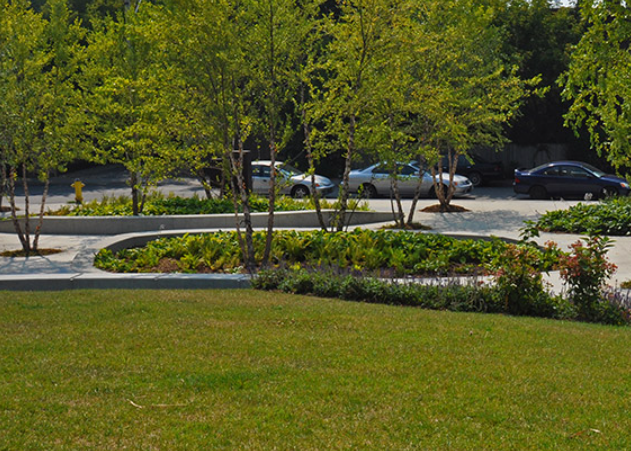
Microclimate-driven plant selection and placement
Our planting choices are governed by careful microclimate analysis. Light levels are mapped at multiple times of day, humidity gradients are observed and airflow patterns are noted so species meet site realities rather than idealised catalog descriptions. This attention reduces replacement rates and supports healthier growth trajectories; plants installed in correctly matched niches establish faster and require less corrective pruning or irrigation. For interior installations we measure seasonal light variance and propose mixes that include low-light tolerant understory species alongside seasonal bloomers placed where available light increases. For rooftop or exposed sites we prioritize wind-tolerant shrubs and drought-adapted perennials with strong rooting characteristics to reduce erosion and substrate loss over time. The outcome is a more resilient green installation with predictably managed maintenance needs.
Integrated irrigation and substrate engineering
We design with substrate and water in mind. Planting modules include engineered soil mixes and drainage layers tailored to species requirements. Where irrigation is necessary we propose low-flow, zoned drip systems with easy-access filter stations and clear shut-off points for winter or travel. Substrate blends are selected to balance moisture retention with aeration and root penetration, reducing compaction and nutrient leaching over time. For modular or living-wall systems we integrate redundant micro-irrigation loops so a single nozzle failure does not compromise the entire installation. These engineering details keep plant health stable and maintenance predictable.
Practical maintenance plans and transparent lifecycle costs
We provide straightforward maintenance packages that outline frequencies, typical tasks and expected consumables. These plans are built to be scalable—simple seasonal checks for residential clients and more comprehensive service-level agreements for commercial sites. By translating horticultural maintenance into predictable budgets and schedules, property managers can include plant care in their operating costs without surprises. Our documentation includes warranty clauses for plant establishment and transparent replacement policies for species that fail due to unforeseen site changes.
Biodiverse palettes that support pollinators and local fauna
We prefer ecological richness over monoculture. Plant lists include nectar sources, seasonal seeders and structural species that provide year-round habitat. Even small terraces can be designed to host pollinators by including native flowering perennials and continuous bloom sequences. Where possible we recommend hedgerow fragments or vertical nesting pockets to encourage beneficial insects. This biodiversity not only enriches the visual field but enhances ecological function, reducing pest pressure and creating more resilient plant communities.
Collaborative design with architecture and interiors
Plant installations are integrated with architectural intent. We coordinate with interior designers and architects to ensure planting supports circulation, sightlines and material palettes. Green elements can provide spatial partitioning, acoustic softening, or wayfinding cues; we approach planting as a design material that complements finishes, lighting and furniture. This collaboration ensures a cohesive final result where greenery enhances rather than conflicts with the built environment.
Sourcing and propagation for hard-to-find species
Our propagation bench and supplier network enable access to specialist varieties and regionally adapted stock. For clients seeking particular cultivars or rare specimen plants we offer propagation and acclimatization services so species arrive established and ready for installation. This capability reduces the need to import immature stock and supports healthier establishment with less shock and mortality.